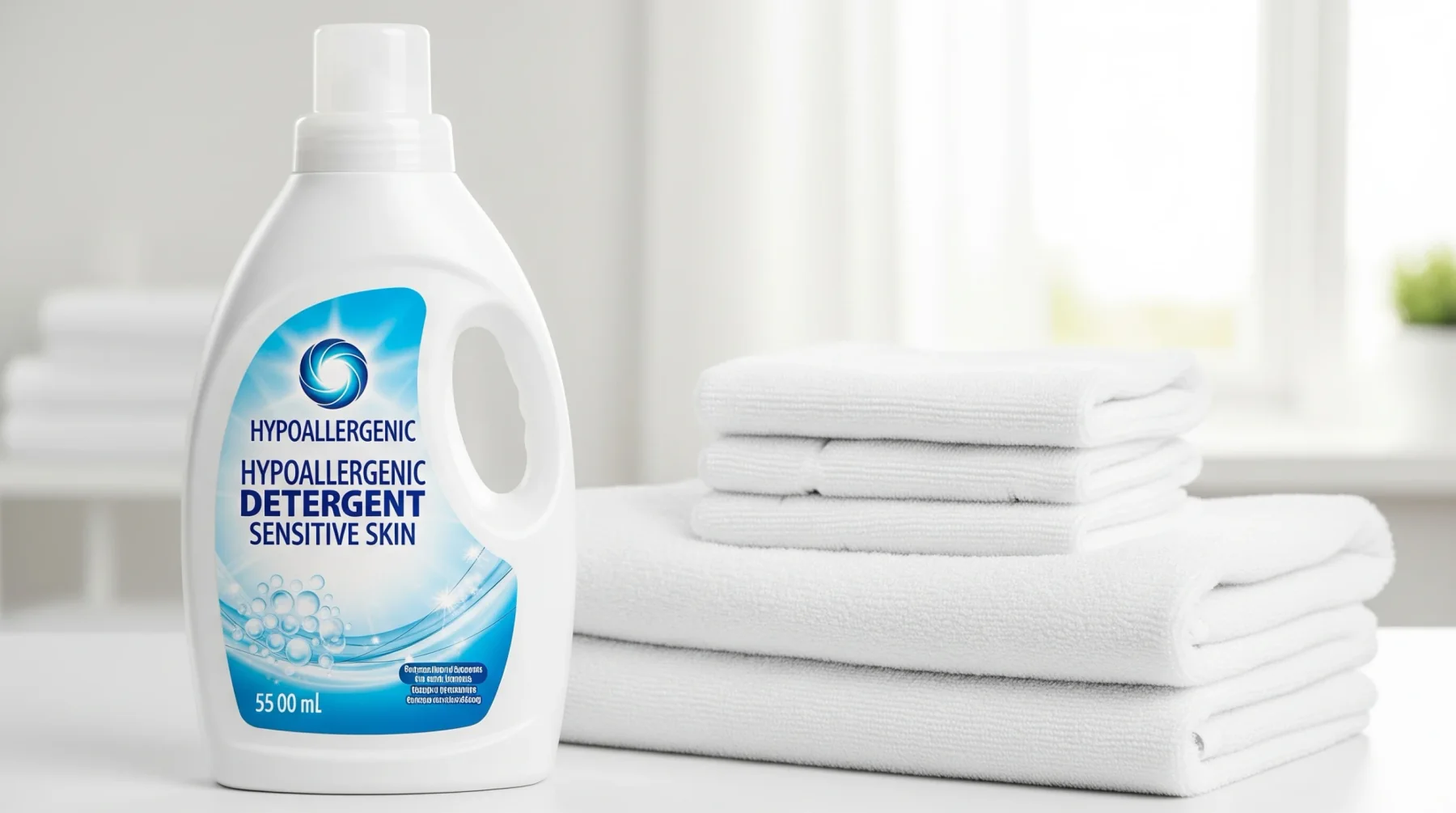
Detergent for sensitive skin should be chosen by its ingredients and individual tolerance, rather than the word “hypoallergenic” alone. No product guarantees that nobody will react to it.
Read beyond the marketing label
Check ingredients, declared fragrance, dosing instructions and fabric compatibility. In its atopic dermatitis guidance, the American Academy of Dermatology recommends fragrance-free and dye-free detergent. Individual medical advice still takes precedence.
A baby, natural or heavily fragranced formula does not by itself establish skin tolerance. Check the particular product rather than assuming every version within a brand is equivalent.
Review the washing routine
- Measure the dose for the load and water hardness.
- Leave room for effective rinsing.
- Avoid automatically adding laundry perfume or conditioner.
- When changing detergent, avoid changing every other variable at once.
- Follow fabric instructions: a skin-oriented product is not automatically suitable for wool or silk.
An extra rinse may be available on the machine, but it does not systematically compensate for overdosing. Stop using a suspected product and seek medical advice for persistent symptoms; this guide cannot diagnose irritation.
Discuss requirements with a laundry
Explain any specific medical instructions or ingredients to avoid and ask whether the service can meet that request. Do not assume a professional service uses a particular formula or a process without contact with other products. With bed linen, discuss finishing as well as detergent.
Frequently asked questions
Does hypoallergenic mean allergy-proof?
No individual guarantee follows from that description. Ingredients and personal response matter; seek medical assessment for symptoms.
Does a weak smell prove there is no fragrance?
Do not rely on smell alone. Read the label and ingredients, and ask the manufacturer about a specific requirement.